



News & Events


Recently, Professor Ying Zhou’s research team from the College of Civil Engineering at Tongji University and the State Key Laboratory of Disaster Reduction in Civil Engineering made significant progress in the intelligent prediction of seismic dynamic responses of building structures. Their research paper, entitled “A Physics-Informed Foundation Model for Rapid High-Fidelity Structural Response Prediction,” was published online in the international journal Nature Communications.
The study proposes a foundation model, SeisGPT, that integrates structural dynamics principles to enable rapid and high-accuracy prediction of the seismic dynamic responses of mid- and high-rise building structures. Professor Ying Zhou is the corresponding author of the paper, and doctoral student Shiqiao Meng is the first author.
The dynamic responses of building structures under earthquake excitation, including acceleration and displacement, provide the fundamental basis for seismic design, post-earthquake damage assessment, and seismic resilience evaluation.
Existing methods for structural dynamic response analysis have long faced a fundamental trade-off among accuracy, computational efficiency, and applicability. Nonlinear time-history analysis can characterize structural responses under strong earthquakes with relatively high fidelity. However, performing nonlinear time-history analysis for a single structure subjected to a single ground-motion record often requires several hours or even several days.
Although existing machine-learning models can substantially reduce response-prediction time, most are strongly dependent on specific structural types and the distributions represented in their training data. When building height, structural system, or member connectivity changes, their ability to generalize across different structures is relatively limited.
To address these limitations, the research team developed the SeisGPT foundation model, incorporating structural-dynamics knowledge such as mass and stiffness characteristics, interstory connectivity, and modal-response propagation mechanisms. Consequently, the model does not simply treat structural responses as generic time-series data. Instead, it learns how the responses of individual floors evolve under earthquake excitation according to the physical characteristics of the building structure. The model was first pretrained using 270,000 automatically generated code-compliant structures and more than 2 million sets of nonlinear time-history analysis data. It was subsequently fine-tuned using nonlinear time-history analysis data from 694 real buildings.
Overall, the training dataset contained more than 10 billion response time steps.
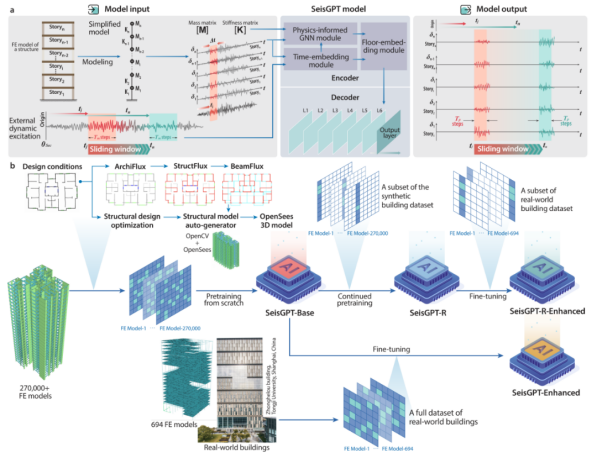
SeisGPT overall framework and training procedure
Image source: Figure 1 of the paper
The model was validated using 3,000 structures that were not included in the training dataset, comprising reinforced-concrete frame structures, frame-shear-wall structures, and shear-wall structures.
The results showed that SeisGPT achieved a normalized prediction error below 5% for floor acceleration and displacement time histories. In terms of computational efficiency, structural response prediction using SeisGPT was approximately 40,000 times faster than conventional nonlinear time-history analysis. Beyond direct response prediction, the model can also reconstruct the dynamic responses of unmonitored floors using measurements from only a limited number of floors. This capability was experimentally evaluated using a 1:10-scale, 43-story reinforced-concrete frame structure in a shaking-table test. By providing only the base ground motion and displacement measurements from 11 floors, SeisGPT was able to predict the displacement time histories at the remaining measurement locations. Under these experimental conditions, the predictions obtained using SeisGPT exhibited better agreement with the measured experimental data than the nonlinear time-history analysis results. For comparison, conventional nonlinear time-history analysis required approximately one to two days to analyze the structure under a single ground-motion input, whereas SeisGPT generated the corresponding structural response predictions within seconds.
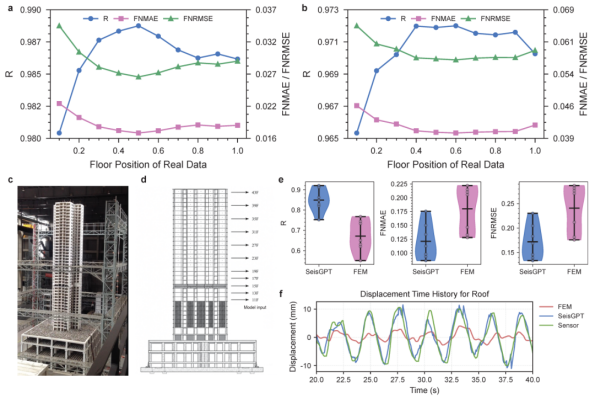
Full-building response prediction from limited floor observations and shaking-table experimental validation
Image source: Figure 6 of the paper
The results demonstrate that the SeisGPT can provide rapid and accurate prediction of the seismic dynamic responses of building structures. Furthermore, using monitoring data from only a limited number of floors, the model can predict the dynamic responses of the remaining floors, providing a new technical approach for rapid and intelligent evaluation of structural seismic responses.
In seismic design, it can support batch evaluation and comparison of multiple structural design schemes subjected to multiple earthquake ground motions. When combined with limited monitoring data, it can be applied to structural health monitoring and digital-twin systems.
In post-earthquake emergency response, it can assist in evaluating building damage states and determining priorities for structural inspection. At a larger scale, the approach could further support rapid screening of urban building inventories and regional seismic-resilience assessment.
Professor Ying Zhou is a Distinguished Professor at Tongji University, Director of the Department of Development Planning and Discipline Construction, Executive Deputy Director of the State Key Laboratory of Disaster Reduction in Civil Engineering, and Director of the International Joint Research Laboratory of Earthquake Engineering (ILEE), Tongji University.
She is a recipient of the National Science Fund for Distinguished Young Scholars and was selected for the Ministry of Education’s Young Changjiang Scholars Program. Her research has focused extensively on seismic resilience of high-rise buildings and intelligent disaster prevention.
Research led by Professor Zhou has received the Second Prize of the National Science and Technology Progress Award and the First Prize of the Shanghai Technological Invention Award. She has also received the Special Prize of the China Youth Science and Technology Award and the XPLORER PRIZE.
Meng, S., Zhou, Y.*, Liao, B. et al. “A physics-informed foundation model for rapid high-fidelity structural response prediction.” Nature Communications (2026). DOI: 10.1038/s41467-026-75508-5

Copyright © 2023 International Joint Research Laboratory of Earthquake Engineering; All rights reseved
 loading......